
As told by Kathy
Armen and I graduated from college in 1974 and in August we began a three-month trip to Europe and the Middle East. I wanted to see the sights of Western Europe that I had heard about all my life – Big Ben and the changing of the guard at Buckingham Palace in England; the Eiffel Tower, the Arch de Triumph and Palace at Versailles in
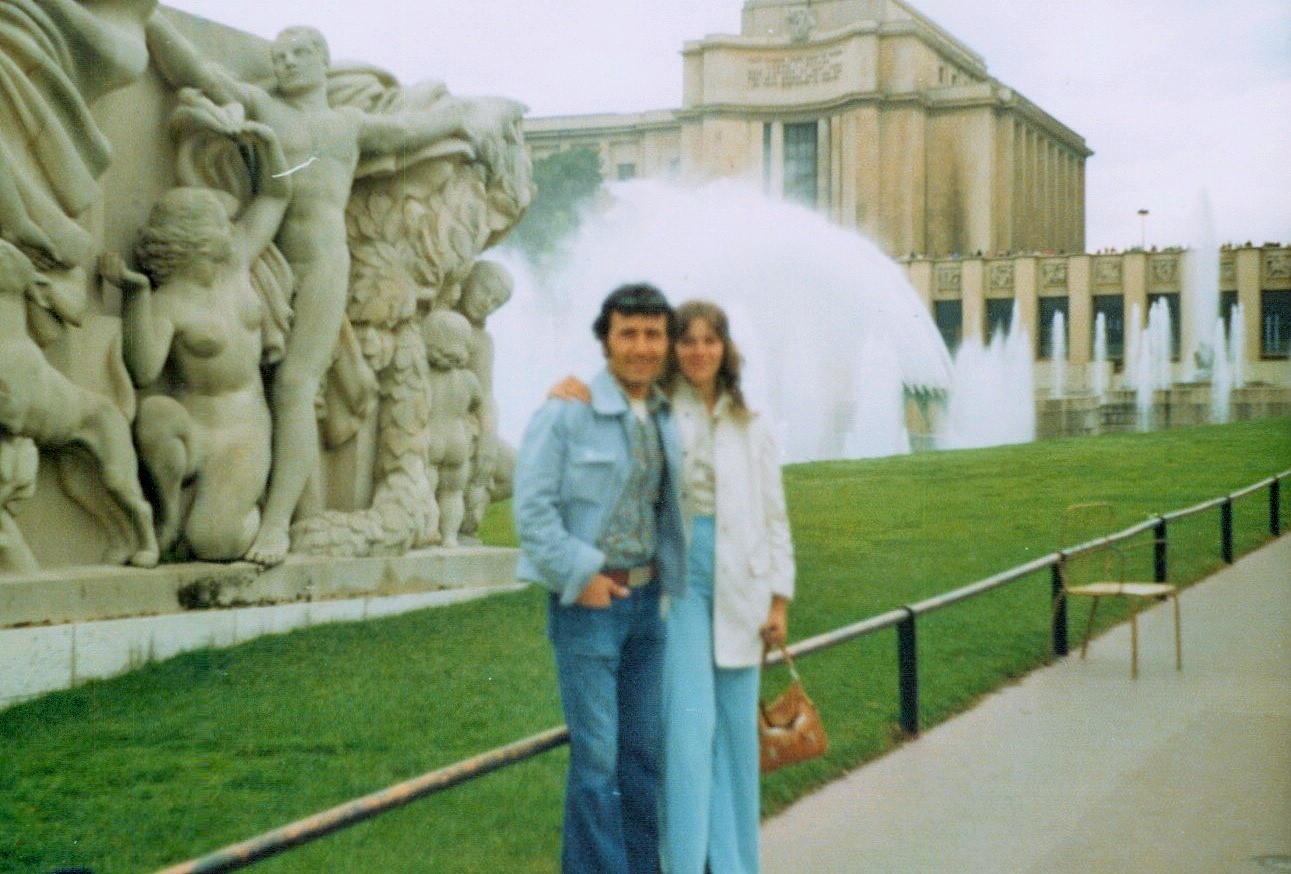
France and, of course, the relics of the Roman Empire in Italy. We saw all that and more as we toured Western Europe for about four weeks and another three weeks in Eastern Europe. Armen wanted to see what life was like in socialist countries as well as take advantage of what he expected to be lower costs for food and other items like cameras there.
PART ONE
We did find a department store in Belgrade, Yugoslavia (Serbia today) but when we went there intending to buy gifts and mementos of trip, we saw that most of the shelves were empty. On a positive note, I remember seeing fathers caring for children – something you saw only very rarely in the U.S. back then, but it seemed quite common in Belgrade. There were few historic features I knew of in Eastern Europe, but it was memorable to see the Danube River.
We took the train from Belgrade and headed to Sophia, Bulgaria. As we settled into our cabin, several people Armen identified as Gypsies piled in with us. They looked like they just stepped off a movie set with their stereotypical clothing: folk-type shirts and blouses with full sleeves and ruffled cuffs, and full skirts and roomy pants made of simple fabrics. They all seemed to have “full figures”, their tight belts and waistbands pressing in on their soft stomachs. The women had full bosoms, their blouses closed tightly at the neck and broad hips covered by all the loose-fitting clothing. The men also appeared to have large chests and thick legs. Armen tried to make conversation with one of the men, but he was very focused on his group and not interested in small talk. We soon found out why.
Just a few minutes out of the station a customs agent entered our cabin asking us to declare any purchases were had made in Belgrade. We didn’t have any because the department store was so empty. We couldn’t understand the conversation between the agent and the Gypsies, but it was clear they also denied having anything to declare. The agent seemed to question this and so as proof, they threw open their bags and satchels to show the agent they had nothing to hide. The agent hesitated, but in the end he left without collecting any tariff.
The agent had hardly exited the cabin when the Gypsies began to transform themselves. They pulled dozens and dozens of colorful silk scarves out from under their clothing, they rolled up their sleeves to reveal silver bracelets and necklaces around their wrists and arms up to their elbows. They took off these and many other items and stashed it all in the bags that had been so empty for the customs agent. A short time later the Gypsies got off the train with all of their scarves stowed in their baggage and we continued on.
It was late at night when we reached the Bulgarian border. We expected to see some sort of station, but instead there was nothing. No building, no platform, not even a shelter like you see at bus stops. Then we got the surprise of our lives. One of the conductors came into our cabin accompanied by a military soldier. He was dressed in fatigues and carried a rifle. He signaled for us to collect our belongings and to come with him. We showed him our tickets to Sofia, but despite language barrier, we understood that we were to go with him. And when we got off the train and then the most frightening thing happened – the train left!
So, here we were, two young people left in the middle of nowhere with this soldier who appeared to be as unsure of the situation as we were. To this day, we still don’t know why they pulled us off the train. Armen tried to find out by speaking to the soldier in French – no response. He tried Arabic and Armenian, but the guard clearly didn’t understand those languages. When Armen tried Turkish the solider did not respond, but something in the guy’s eyes told Armen he understood. (Note: when travelling abroad, be sure to have a polyglot as one of your travelling companions!)
One of the things that first interested me about Armen was that he knew a lot about political systems, and socialist systems in particular. At that moment at that desolate spot along the Yugoslav/Bulgaria border the most important thing he knew was that those Eastern Block countries were always in need of Western currency. We weren’t wealthy travelers by any means, but we did have nearly $1,500 in Travelers Cheques. (There were no ATMs in those days). We pulled them out to show the guard and, speaking in Turkish, Armen explained that we intended to spend that money in Bulgaria. It worked. About an hour later, another passenger train stopped at the border and the soldier escorted us on board.
PART TWO
We went to the visitors’ office in Sofia to find lodging and discovered that for not too much money, we could rent a room adjoining someone’s apartment – clearly this was the predecessor to today’s Air BNB. It was a clean space with a private entrance and a balcony overlooking a main street. The next morning as we drank coffee on the balcony we noticed that people were lining up on both sides of the street below apparently to watch some sort of parade. We could see the beginning of the parade several blocks down the street and had just settled in to enjoy it when two large men barged into the apartment, charging directly at us and insisted that we step back into the apartment.
It turned out that the parade was part of a celebration of Bulgaria’s 30th year as a socialist country. In recognition of the occasion, the leader of North Vietnam was visiting and he was riding in the parade. The balcony we had been sitting on was a perfect spot from which to shoot someone in the parade. Remember the year was 1974. America’s involvement in Vietnam would soon some to an end, but it hadn’t ended yet. And so the prospect of an American (me) located on a balcony above the street on which the leader of North Vietnam would travel was too hazardous. Out an abundance of caution – and not wanting to be arrested – we decided to forego watching the parade. And the security officers made sure we didn’t, sticking around until the parade had passed.
That evening we did enjoy a wonderful multi-course meal for only about four dollars. Afterward we went for a stroll when suddenly we heard bombs exploding from about a block away. We could see the flare of each explosion and the sound was deafening, but no one else seemed to be concerned. As we rounded corner we realized these weren’t bombs but fireworks – more celebrating the country’s anniversary. It was really the first fireworks display I’d ever seen. Coming from Alaska where the long summer days wash out even the brightest fireworks, and it was spectacular.
After a few days in Sofia, we were ready to move on, but getting out of Bulgaria proved nearly as difficult as getting in. From Sofia, we planned to fly to Beirut, but there was one problem; we could purchase our tickets from only the visitor center and they refused to allow us to leave for another week.
PART THREE
We finally got to Beirut in mid-October. Several of Armen’s relatives had gathered at his sister’s house to welcome him home. There was great feasting and lots of conversations and catching up. Remember, there was no Internet or cell phones and in the Middle East, few people even had a phone. In the five years since he had left home, Armen had communicated with his family very infrequently through short letters and very occasional phone calls. So they had a lot of catching up to do.
Amen had grown up in Syria, but he was not able to return there because he had left on an exit visa to Italy and illegally went to the U.S. instead. But he wanted me to see his home town so I traveled to Damascus and his home town of Aleppo with his nephew, Kapo, who had a good command of English. We visited his relatives in Syria, including his brother Hovhaness and landmarks such as a 2,000 year old suq, the ancient Citadel that protected Damascus for centuries, and, of course, Armen’s childhood home.
The only downside was I was getting eaten alive by mosquitoes. So we headed to a pharmacy for some repellent. Surprisingly, they not only didn’t have it, they didn’t even know what it was!
Pharmacy after pharmacy, it was the same response. Finally, we entered a pharmacy and as Kapo began explaining in Arabic what we were after, the clerk turned to look at me. My blue eyes, fair skin and light-color hair revealed my Western nationality and he said in English, “Oh, you want mosquito repellent.”
“Yes!” I said. Finally, someone knew what I was after! The clerk’s response was matter-of-fact, “We don’t have that,” he said.
I traveled two more times into Syria. The third time was during Ramadan, the Muslin holy month of fasting. We were taking a bus this time, and the station was packed with followers of Islam trying to get to Mecca as part of the religious observance. When it was announced that our bus was available for boarding, the crowd surged toward the door of the bus. Just then an officer who was on the bus appeared in the doorway, blocking those trying to get on. When they pushed forward, he drew a Billy club and threatened to hit them. When I saw this, I turned around and began walking fast away from the potential altercation. Kapo called to me, asking, “Where are you going?” “He’s going to hit people,” I said. Forgetting that I knew neither the language nor the culture, Kapo said in disbelief, “He’s threatening them so you can get on!” I turned back and sheepishly boarded the bus. At least I could prevent others from being injured.
On the way out of Syria on that third trip, we took a taxi to Beirut. It’s the custom there for taxi owners to predetermine their destination and then wait in a public place like the town square for enough riders to fill their car. As we neared the Lebanese border, we saw a long line of taxis waiting to go through the border checkpoint.The driver suggested to Kapo that he and I walk up to the front of the line since as a foreigner, I would have to fill out a lot of paperwork to cross the border while for the other passengers, it was much simpler, like U.S. citizens crossing into Canada.
I finished the paperwork and while I waited for our car to get to the front of the line, one of the border guards struck up a conversation straight out of an English language text-book, “How many brothers and sisters do you have?” he asked. “How old are they?”
When the car arrived, the guard asked if I had any purchases to declare. I said yes and showed him the packages in the trunk. Apparently as a compliment to me, the guard covered his eyes as he stamped each package with acknowledgement that no tariff need be paid. I expressed my appreciation for this, recognizing that he had done me a favor.
We got in the car and started to drive away when the guard suddenly started chasing the car, calling for us to stop. He swung open the back door, pointed at me and said in English, “You. Get Out!” Puzzled and now almost frightened of what was happening, I got out with Kapo who could translate if need be.
While we stood by the car, the guard slowly looked around to the left and then to the right. Then, in a quiet voice asked, “What are you doing Saturday night?”
Surprised doesn’t quite describe my reaction, but I was flattered and wanted to let the guy down easy. So, I told him that I was leaving to go home on Friday, thanked him for the invitation and said goodbye. When Kapo and I climbed back into the car all of the other passengers wondered what had happened. Kapo explained in Arabic that the guy just wanted a date. They all had a good laugh and clucked their tongues.
 Meekins Family Stories