A few things you don’t know about Ambrosia

Kathy’s Speech to Greeters Group, Eugene Area Chamber of Commerce

9/9/16

  • wood-fired-oven
    Ambrosia was the first restaurant in Oregon with a wood-burning pizza oven.

    I’d wager that most of you are familiar with Ambrosia Restaurant – after all, when you’ve been around for 29 years your customers and community members are bound to know a lot about you such as that Ambrosia has been an anchor business in Downtown Eugene since 1987.

  • Today, I’d like to share a few things you may NOT know about Ambrosia.
  • Ambrosia has weathered the economic ups and downs of the past three decades by being creative, innovative and committed to giving our customers the best possible dining experience. And that commitment extends to our employee, too.
  • We currently employ 27 people in full and part time positions
    • Several of them have been with us for decades
    • We’re proud to note – for first 26 years; same chef
    • Current chef with us for 25 years
    • Our dishwasher of 22 years just quit because he got old.
    • Several wait staff with us for 10, 15 or more years
  • As you may know, Ambrosia is located next to the historic Quackenbush Building. Many people think Ambrosia is an historic building also.
    • But it’s not
    • In fact, the Ambrosia building was built in 1976 by an antique dealer who operated Old Town Pizza at that location until 1986 – the only other business that has operated in that building.
    • It was designed to look old to complement the Quackenbush building, using distressed bricks and mortar that looked like it came from an earlier era.
  • Unfortunately, Old Town Pizza was a casually of Oregon’s economic downturn in the 1980s. The owner simply walked away leaving the building full of beautiful antiques, including the back bar, which is said to have come out West over the Oregon Trail.
  • The antique dealer’s misfortune was a blessing for my husband, Armen Kevrekian, his friend from the old country, Zareh Marashlian, and Frank Ernandes, who owns Mazzi’s.
    • The three of them dreamed of opening an upscale Italian Restaurant that would offer something that no one else in Oregon had: a wood burning pizza oven.
      • Back then, no one made those ovens in the United States, so we had to get it from Italy
      • But we didn’t realize until it got here from Milan that it wouldn’t fit through the door
      • So, we made a hole in the wall and got it in that way.
      • It was a big hit, of course, and still is.
      • Since then the wood fired pizzas ovens have proliferated. Many other restaurants followed our lead and got ovens of their own.
  • One thing we are especially proud of – is Ambrosia first jobs we have provided to dozens of young people
    • Hostess, busser, dishwasher are entry level jobs, and we take care to provide the training and information they need understand what a job requires of them
    • We provide them with the training and information they need be a good employee and successful member of the workforce.
    • That training serves them well and helps them move on to other jobs and careers
    • And occasionally there’s pay back, too
      • Late one night when Armen was coming home from a long day of working at Ambrosia, he was stopped by a cop for ‘rolling through a stop sign’ He thought for sure he’d get an expensive ticket.
      • But it turned out the officer recognized Armen as his former employer! The officer got his first job at Ambrosia and apparently appreciated that. He let Armen off the hook, warning him that he shouldn’t risk having an accident because, as he said, “there are lots of people who want you to stick around.”
  • Over the years, Ambrosia has been the location of many first dates and second, third and more dates that led to marriage proposals and a family
    • Those couples brought their children to Ambrosia. And now we’ve been in business so long that those children are now adults and bringing their own children to Ambrosia!
  • Perhaps the strangest life milestone involving Ambrosia had to do with a guy named Ken. The first day we opened, Ken was our very first customer.
    • He soon became a regular at Ambrosia
    • And when he got married, he and his wife frequented the restaurant
    • Unfortunately, their marriage soured and they decided to divorce.
      • It was not an amicable divorce and things got so bad, Ken dreaded the thought of ever running in to his ex – especially at his favor restaurant: Ambrosia.
      • He thought his visits would be ruined by her presence, so as part of the divorce settlement Ken’s wife agreed never to come to Ambrosia again.
  • You may also know about Ambrosia’ reputation for having great wines from the world over.
    • We love introducing our customers to these wines and have held wine tastings for more than 20 years;
      • But unlike most other wine tastings, Ambrosia’s tastings are really a wine class – Armen, who is a Certified Sommelier, delights in helping customers learn about and appreciate a variety of wines.
      • Ambrosia’s wine tastings are actually wine classes. They are sit down events with knowledgeable presenters who provide information and answer questions. (In fact, we have another one next Tuesday.)
      • you may not know that Wine Spectator magazine pres000ented has named Ambrosia’s wine list as one of the best in the world – an honor given to only 2400 restaurants worldwide!
      • And Ambrosia has received this recognition not for just 1 year, or 2 or even 10; but for 26 years
      • This year we were also presented with Trip Advisor’s award of excellence based on customers’ reviews
  • For 29 years, Ambrosia has been a constant among Eugene’s restaurants
    • We credit our success to consistently serving excellent food, providing excellent service and evolving in response to our customers’ wishes.
  • You may not know that our latest evolution is to offer Sunday brunch as only Ambrosia can.
    • You’ll find our brunch menu on the tables, along with a coupon for a free mimosa when you buy a brunch entrée.
  • It’s been a long and rewarding 3 decades for Ambrosia Restaurant; we are looking forward to enjoying many more.
Nelson Comes Home

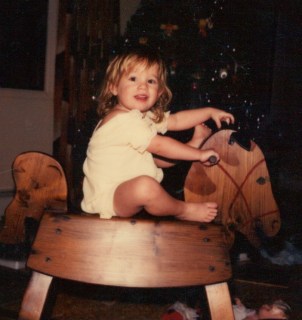
Elissa on Rocking Horse
Two-year old Elissa gets a rocking horse for Christmas.

When Elissa was just a little girl, Santa brought her a hand-made wooden rocking horse. It had a painted face, mane and bridle with leather ears.  The horse lived happily at our house in Anchorage and was ridden and enjoyed for many years. When we moved to Oregon in 1989, Elissa, then 12, and Gregor, age 7, had long outgrown the horse, so we left it behind.

The horse lived at Gramma ‘Del’s house for nearly two decades where he had a long history of riders: Susan’s two youngest: Catherine and Moira; plus her grandchildren Shanleigh and Collin, and all of her son Conor’s kids when they came to visit.  The horse lived for a while at Park Place, Susan’s condo, and went to Fairbanks when Susan moved there and then back to Gramma’Del’s. Tim’s daughter Shanleigh named him.  When asked what she called him and she replied “nussin'” meaning ‘nothing’ but Susan, Timmy and Terrill thought she said “Nelson”, and so Nelson he was.  And here she is riding “Nelson”.

After years of hard riding, Nelson became very wobbly; almost falling apart.  Susan took him to the veterans’ workshop, and they completely rehabbed him, making him more more sturdy.  The Vets also re-varnished him and smoothed out many scratches.

But with Conor’s family visits being few and far between and all the other grandchildren having outgrown the Horse, he needed to come back to us. But how?

Every time I visited Anchorage I thought about bringing the horse to Oregon, but despite the best of intentions, I never seemed to be able to find the time during those fleeting trips. When I came to Anchorage for Catherine and Andrew’s wedding the summer of 2016 and saw the horse taking up space in Susan’s living room, I knew two things: it was in the way at her condo and it was time to bring him home.

Although light weight, the horse is bulky. He’s 43″ long; 29″ tall and 23″ wide and the logistics of shipping him proved daunting. The package would have to be so big that the USPS, UPS and Fed Ex wouldn’t take it; they didn’t even have a box big enough. When I learned that shipping him to Oregon as freight would cost as much $500, that was out, too. (Don’t get me wrong, I love Nelson; I just don’t love him $500 worth.)

But we weren’t going to give up easily. As it happened, Susan’s daughter, Moira, famously transported a hope chest – a package the size 0f a refrigerator – from Washington DC to Anchorage for little to no money. She was the one to ask. Her advice: check it as over-sized luggage on my flight home! Following the “easier to get forgiveness than permission” axiom, we set about building a box in which to pack Nelson.

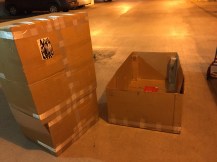
box before 2
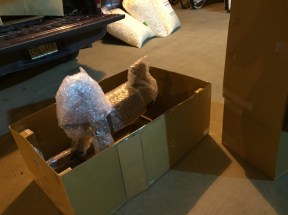
Our home-made box
horse in a box
Wrapped and ready for packing peanuts.

We started with two large boxes and, using a generous supply of tape, we affixed them
together making the top and bottom of the box measuring 4 feet long, 3 feet high and more than 2 feet wide. We covered the horse in bubble wrap, filled the box with a generous supply of packing peanuts, taped the top and bottom boxes together, loaded it on Catherine’s truck and headed to the airport.

The first counter agent cast a skeptical eye on the large box, but scanned her computer to find out if it would fit on the small prop planes that fly between Seattle, Portland and Eugene. She said that although the cargo hold was large, the door into the storage area was small; probably too small for my box, but was unable to find any specific information.

She directed me to another agent who escorted me and the box to the “oversize baggage” counter. As we walked across the floor, she said, “Just eyeballing it, it’s too big.” I asked, “How much too big?” and was shocked when she said it would have to be repackaged to half the size. “Impossible”, I thought, since the rockers alone were 43″ long. This was a devastating let down. We had worked so hard to build the box and pack the horse, and there was just no other affordable way to get it to Eugene. And what on Earth would Susan do with it?  Feeling discouraged, I nevertheless spoke with a third agent at the Oversize Baggage counter.

Loading at Portland.JPG
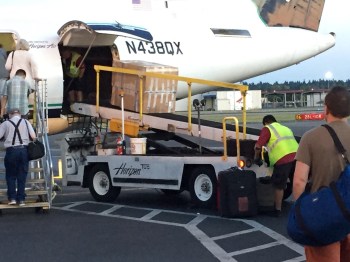
My box with Nelson inside being loaded for the last leg of the trip home with plenty of room through the cargo doorl

I was happy to see that rather than just “eyeballing” it, he  took out a measuring tape to get the precise size and wrote down the measurements. He disappeared into the back offices of the airline for a few minutes and when he returned he said simply, “It will fit.”

I wanted to jump for joy.  He affixed the baggage ticket and instructed me to take the box to TSA security where the guard there said grumpily, “You know I’ll have to open it up.” So much for our secure “Frederick Magnier/Gramma ‘Del” packaging job that took tree rolls of tape and covered nearly every inch of the box. But hey, the horse was getting on board! To save the TSA guy some headache, I told him the packing peanuts were loose in the bottom of the box; but they  were in bags in the top of the box.

When I passed the TSA station an hour later, it was a little disconcerting that the box was still there and appeared to be untouched. I boarded my plane with the nagging feeling that I would be getting a phone call telling me the box was still in Anchorage or stuck in Seattle, unable to be loaded onto the small Horizon Airline plane.

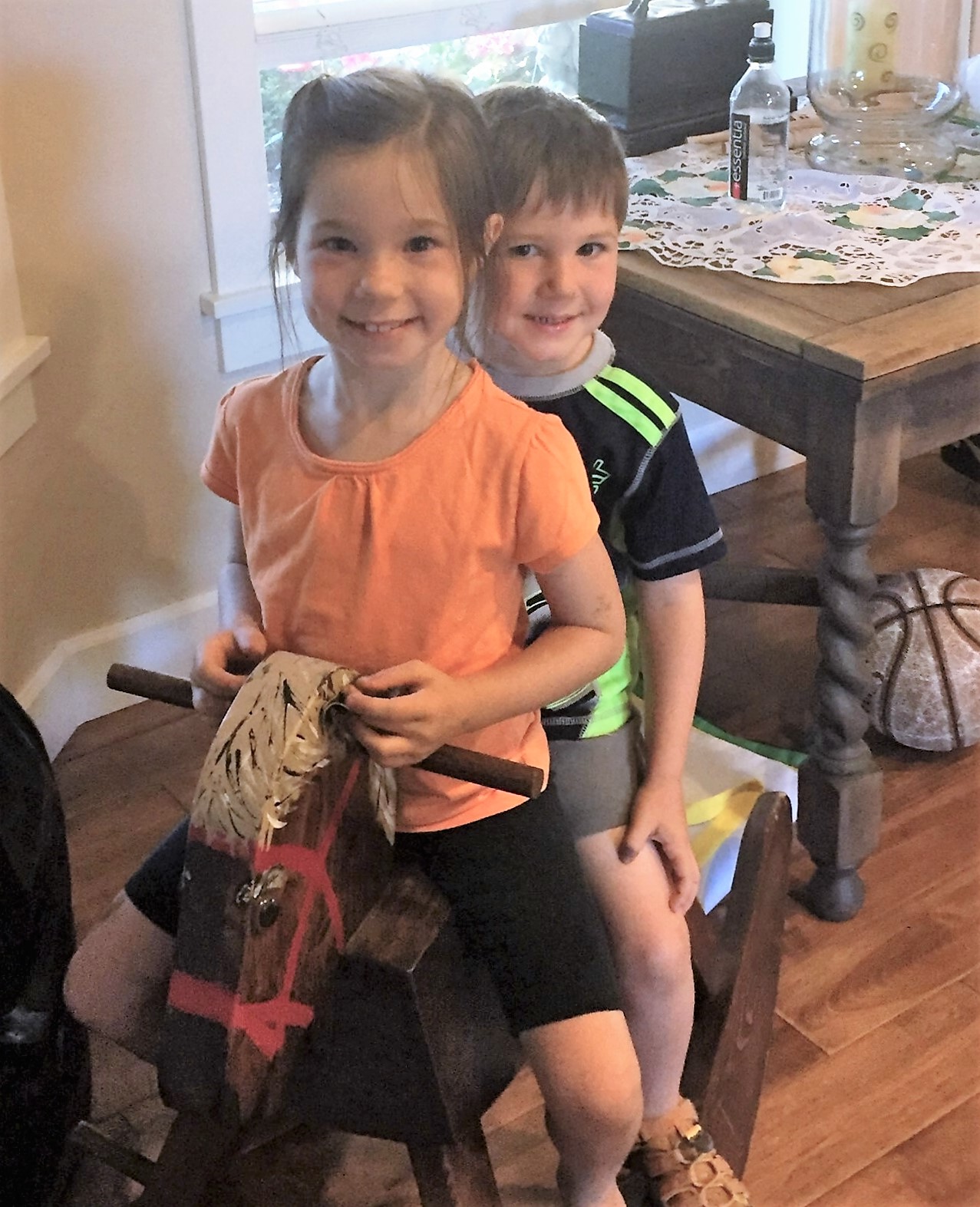
Elsa and Liam take Nelson for a rde.
Elsa and Liam take Nelson for a rde.nable to be loaded onto the small Horizon Airline plane.

You can appreciate my delight, then, when I boarded my plane in Portland and saw the box being loaded onto my plane, easily fitting through the cargo door. I wanted to shout out, “That’s my horse! He made it!” But I just took a picture to share on Facebook.

There was just one more hurdle for Nelson. Would  the box fit in the back of my SUV? Well, kind of.  Armen and I could not get the package entirely into the back of the SUV, but we shoved the box as far in as we could; enough to get it good and “stuck” and drove home with tailgate open and the package hanging halfway out. It worked, and we got Nelson home safely.

And this week, he took the next generation of kids for a ride.

Coming to Alaska

As told by Barb with Pam Meekin

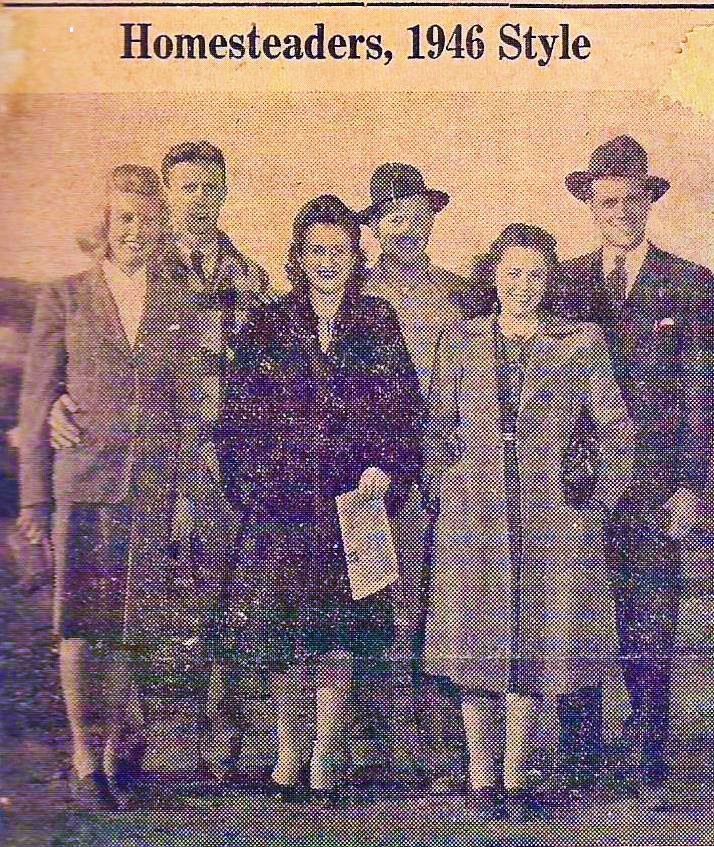
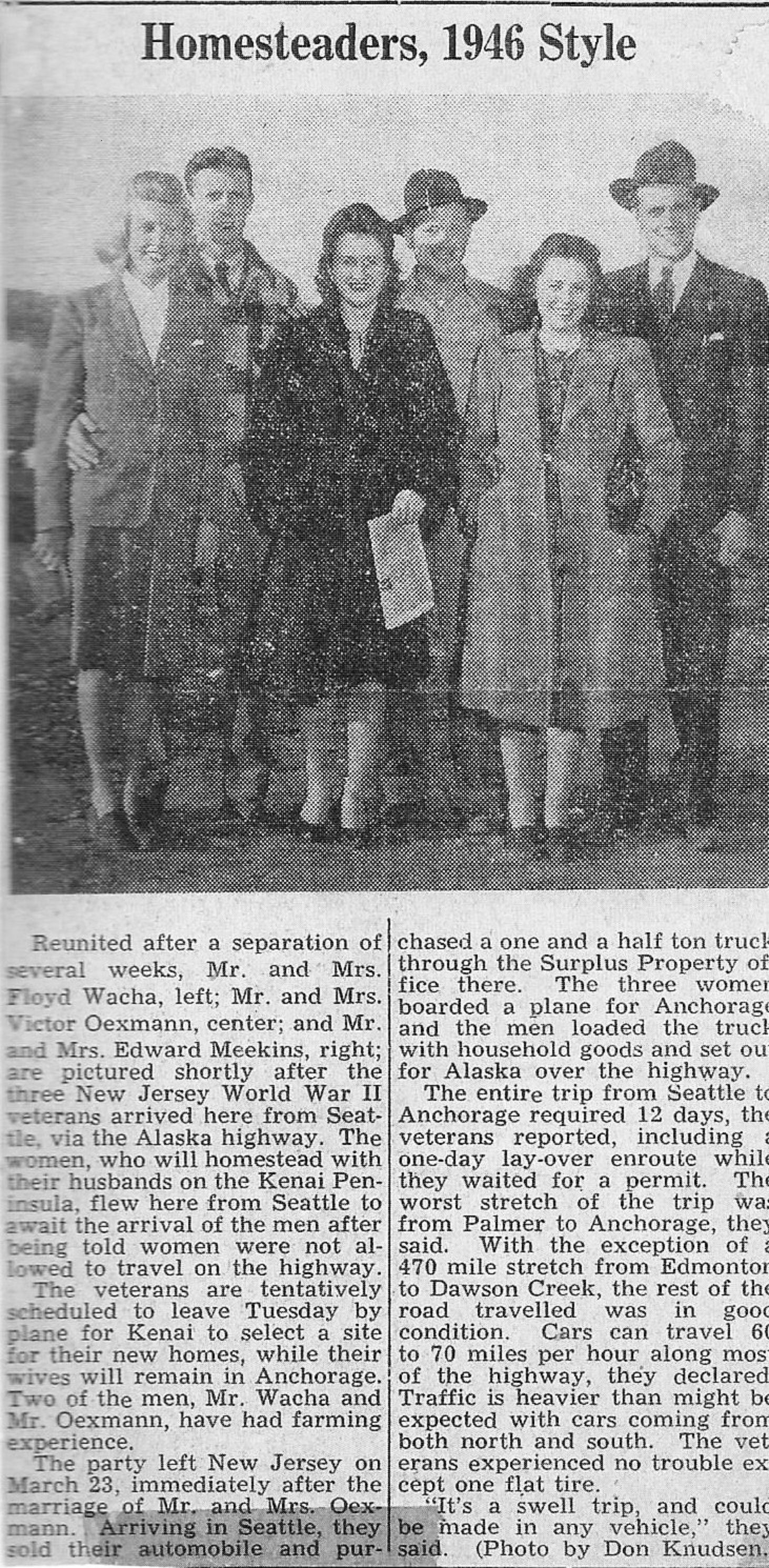
The Anchorage Daily Times reported Mom and Dad's story of coming to Alaska after the war with two other couples.
The Anchorage Daily Times reported Mom and Dad’s story of coming to Alaska after the war with two other couples.

Mom and Dad married shortly after WWII and then set out on what was to be a five-year adventure to Alaska. They and two other couples planned to drive from their homes in New Jersey across the U.S. and then on to Alaska via the just-constructed Alaska Canadian Highway. The U.S. government built the 2,200 mile-long gravel road from Seattle, Washington, to Fairbanks, Alaska, during the war to provide an over-land route to the northern U.S. Territory should the Japanese invade it during the war. Except for a few islands in the Aleutians, however, the Japanese never did invade, but the road endured as a passage to adventure.

The three young couples had a great time driving across the country. Their plans hit a snag when they got
to Seattle, however. The military still controlled use of the road and in an apparent effort to prevent prostitutes from travelling to Alaska, women were not allowed to use the new road unless they had jobs at the other end.

The plan was for men continue on the last long leg of their adventure while the women waited in Seattle. Once the men arrived in Anchorage and found a place to live, they would send for the women to fly up.  It took five weeks for the guys to make it to Anchorage because the road was very rough in the best of conditions and, this being springtime, was very muddy in the worst. Besides, the men were dawdling along the way to fish and otherwise enjoy the adventure (after five years of war).  But the women didn’t wait.

bragging rightsMaybe it was because they had become so self-reliant during the five long years of the war working as stenographers and secretaries or maybe it was just the nature of any woman who would even be a party to such an adventure, but within a few days of the men’s departure, the three women learned of a military office in Seattle hiring civilian women for Alaska. They signed up and arrived in Anchorage on April 23 – three weeks before the men!

While they waited for the guys, the women stayed in the Bachelor Officer Quarters on what was Elmendorf Air Field; it was not yet an air force base but part of Fort Richardson. When the guys got there they were not allowed in the BOQ so were very inspired to find housing to get their wives back.

The two other couples stayed in Alaska for about a year before returning the “civilization”, but Mom and Dad stayed to raise our family and give opportunity for all of these stories to come to pass.

New Homsteaders article2


Recorded by Kathy Meekins Kevrekian

Spilling the beans

As told by Susan; recorded by Kathy~

One 4th of July holiday my sisters, Kathy and Genie, and I decided it would be fun to go camping. Mom and Dad had gone to Seward over the holiday to watch our brother Russ run in the Mt. Marathon Race, so we were on our own.  For food, we decided to make baked beans. They would be hearty, nutritious and easy to make: a little water, some bacon, onion, other seasonings, no sweat.

I have always loved to bake and, if I do say so myself, I do so with a flourish – along with just about every mixing bowl, baking utensil and counter-top in the kitchen. Mom was pretty impatient with my “baking style” and the cleanup required afterward, so while she was out of town I couldn’t miss the opportunity to bake. Little did I know what I was about to get myself into; not to mention the entire kitchen.

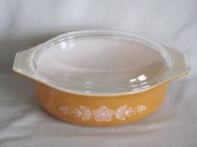
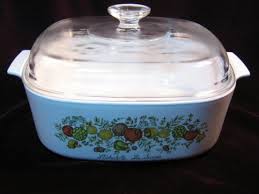
The recipe called for navy beans, but the store had just small bags that each had only about two cups of beans. That didn’t seem enough for the three of us, and since beans get better after a few days, we wante2 quart casseroled some left overs, so I got four bags. Mom had a good-size t casserole, which is a deep dish with a lid. It held four quarts which was plenty big for 8 cups of beans so I poured in the beans, added enough water to cover them and left them to soak.
Meanwhile, Kathy and Genie had found a tent (and enough stakes to put it up) and I helped them round up sleeping bags for each of us and started packing other things we might need, including Dad’s 357 pistol. You never know when you might encounter a bear in the wilds of Alaska, after all. When we checked on the beans a little while later, they had swelled up so much that they were almost to the top of the casserole. Mom didn’t have a bigger pot, so we went to the local grocery store and bought the largest pot they had: a large metal pot called a Dutch oven that held eight quarts twice size of the casserole. We agreed that it would be more than big enough. But we hadn’t considered one thing – the other ingredients we still needed to add.

5 qt dutch ovenBy the time we got back to the house the beans had soaked up all of the water and over-flowed the casserole. We dumped them all into the Dutch oven. But when I started frying up the half pound of bacon and sautéing a couple of minced onions, I realized there wouldn’t be room for these ingredients plus a cup of brown sugar and generous portions of tomato sauce and other spices. Unbelievably, we needed a bigger pot.

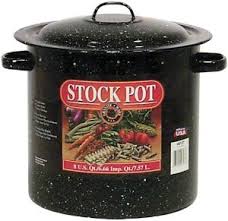
We decided to go to Kimball’s a household store downtown where we regularly shopped for presents for Mom. They had a great selection of tea cups that were ideal for her collection. In hindsight, I’m not s12 qt stock pot2ure Mom ever actually collected tea cups. I think we just created the collection by buying her the cups for every gift-giving occasion. The store had lots of fun and fancy kitchen dishes and specialty utensils and, of course, those pretty little cups, but they didn’t have anything even close to big enough for our project. We asked the clerk if she knew where we might find a big pot and she suggested an Army Navy Surplus store. There we found a 12-quart (3 gallon) stockpot.
All this pot changing and cooking was starting to take a toll on the kitchen. The sink was full of used cookware and most of the counter space either had beans on it or evidence of the other ingredients. The clean-up could wait, I thought; we had to get these beans in the oven. Thankfully, all of the beans and ingredients fit into the stock pot and it fit in the oven, set at 350 degrees. Now the beans just needed to cook.

It was about then that my boyfriend, Ron Cupples, showed up. He wanted me to go somewhere with him and was quite put out when I told him that my sisters and I had plans to go camping at McHugh Creek Campground. Telling him where we were going turned out to be a near fatal mistake, but at that moment I thought revealing our destination made our plans more concrete and helped to encourage him to leave. Once he was out of the house, I noticed the beans smelled like they were burning. When I opened the oven to check on them, I couldn’t believe my eyes.

The beans were boiling over this 3-gallon pot! I should have put a cookie sheet under the pot, but it was too late now. The spilled beans fell onto the heating coils and their charcoal remnants were welded on to the floor of the oven. And, the boiling pot had splattered all over the inside of the oven. This was a mess even by my standards. The only thing I could do to stop it was take the pot out of the oven. We needed a bigger pot, but we couldn’t think of another store that would carry the size pot we needed. But I knew who would.

I called my friend Bonnie. There were 15 kids in her family; surely she would know where to buy a commercial-size pot. Bonnie suggested a store called Brewster’s in Mt. View. With the beans off the heat, we headed across town to our last hope of finding the pot we needed.

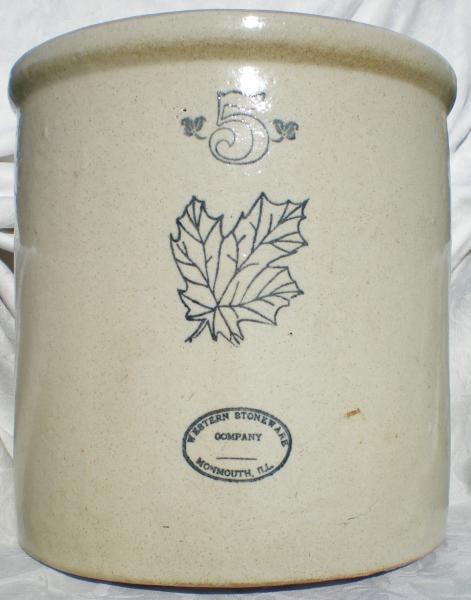
5 gallon crock potBrewster’s was an old-fashioned dry goods store and it was amazing. We could have spent the rest of the holiday just marveling at the variety of items they sold – everything from hardware to dress cowboy shirts; and an entire section of the store devoted to cookware, including what today we might call the “mother of all pots” – a 5-gallon ceramic crock pot. The girls and I managed to carry the behemoth to the car and then into the house. We placed the crock pot on the floor and poured the beans from the stock pot. Then, I lowered the oven rack to the lowest position and put the ceramic pot in for what we hoped would be the last 30 minutes of cooking.

Once I closed the oven door, we all took a good look round.”It looks like The Cat in the Hat was here,” Genie said and we all laughed remembering the story about that messy visitor. But it was true. the sink was full of dishes and utensils, and beans were everywhere! They were on the floor, the oven top, the table top and practically every counter top. But the real mess was from the other ingredients. Cutting, measuring and pre-cooking the ingredients had dirtied a cutting board, knife, frying pan and bowls to store them in while we shopped for bigger pots. And as the pots got bigger, the difficulty of pouring the bean mixture from one to another increased exponentially. As a result there were bean-colored drips and splotches everywhere. I tackled the dishes in the sink and the girls worked on all the drips and splatter. When the buzzer rang 30 minutes later we didn’t exactly have the kitchen back to its original clean state, but it was nearly there.

Finally, we were ready to go camping – I packed up a about a quart of the beans and left the rest on in the crock pot on the counter – there was nowhere else to put it!

We drove out to McHugh Creek Campground, which was only about 30 minutes away, and with plenty of Alaska summer daylight left, we climbed a short way up a hill where we pitched our tent and arranged our sleeping bags and other belongings inside. I put Dad’s gun just inside my sleeping bag so it would be handy-by should I need it. We had a great time singing camp songs, playing card games and as it got darker, telling scary stories. The best part was the beans – they were delicious!

As we got ready to sleep, I heard a noise outside the tent. I could hear it breathing heavily as it stumbled up the hill and wandered through our campsite. I grabbed Dad’s gun and pointed it at the door of the tent, ready to shoot if the bear came near our tent. The intruder’s shadow got bigger and bigger as it came toward us. Quietly, the girls and I scooted to the back of the tent, as far from the door as possible. Closer, closer it came. I pressed my finger tighter on the trigger.

“Susie?” someone said.

For a moment I couldn’t believe my ears. I looked hard through the darkness at the shadowy figure. It wasn’t a bear; It was Ron Cupples!  If  he hadn’t called my name I surely would have shot  him! Reeling with the knowledge that I nearly killed someone, plus the fact that he was making a pest of himself, I lashed out at him with adrenalin-stoked anger and told him in no uncertain terms to leave us alone. He got the message and stumbled back down the trail to the parking lot.

When we got  home the next day, Mom and Dad were in the kitchen. Mom was scrubbing the stove top and Dad was sitting at the kitchen table eating a bowl of our beans. “Where did these come from?” He asked. “They’re delicious.”  Mom turned around as if she was curious about the answer. But as she went back to scrubbing, I had a hunch she already knew.

But, not about the ‘spill the beans’ on our cooking adventure I said simply, “Oh, they’re just a little something I cooked up.”

Finding Meekin’s Lodge

As told by Barb, Kathy and Pam Meekin; recorded by Kathy-

If there was one downside to growing up in Alaska it was that we were a looonnngg way from any relatives – about 4,300 miles to our closest family in New Jersey; another 300-500 to our Florida relatives.

A few times when we were young, the family went the full distance for a visit. The usual itinerary was to fly to Seattle and take a train to Detroit (or fly to Detroit), pick up a car eventually intended for Dad’s lot, drive to New Jersey to see all those relatives, and then, sometimes, down to Florida to see Aunts Dot Ryan, Isabelle Rydberg and Isabelle Meekins, and their families. Then Dad would drive all the way back across the states to the Canadian border and up the still mostly gravel Alcan Highway.

On this day, we were almost home – a little more than 100 miles to go. Mom and Dad were hoping to make it all the way to Anchorage but we didn’t make the time they hoped. As it grew later and later, they became quite worried about where we would spend the night. They set their sights on making it to Palmer, which was only 50 miles away.

Meekin's lodge
Meekin’s Lodge

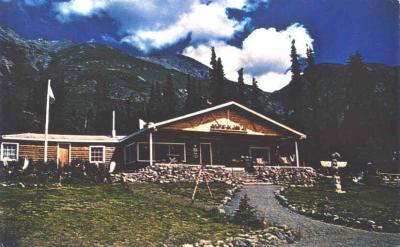
Just outside of Sheep Mountain, they came around a curve and saw a sign for Meekin’s Log Cabin Camp (it would later be known as Meekin’s Lodge).  Our family name is Meekins (with an ‘s’), so upon seeing this, Dad just had to stop and meet this poor-spelling relative. He said, “Well, I guess this is where we’ll spend the night.”

Austin Meekin and his wife Dorothy (Dot for short)  grew up in Wisconsin, and traveled north after the war with the intention of opening a dude ranch in Canada but just kept going until they saw the Sheep Mountain area, fell in love with it and decided to settle there.

In the summer of ’46 they lived in a homestead up on the mountain and  filed for a Trade and Manufacturing Site (part of the homestead act for business sites) on the adjoining lot, where they eventually built their lodge and in ’47 or ’48 began a business guiding hunters into the surrounding wilderness for moose, bear or sheep and Dot was responsible for the dining room, upkeep of their cottages available for rent to clients or travelers as well as the care, feeding and schooling of their (eventual) six kids.

Dad and Austin hit it off immediately, despite begin polar opposites politically, the two men share a common loyalty to the states, both having served during the war; Austin in the army and Dad in the Marines. Both came to Alaska right after the war, fell in love with the place, owned their own businesses and had a passel of kids.

Barb’s story 

Over the years, our two families became good friends. There would be five siblings in my family; so there was someone of nearly the same age in the Meekins clan for every child in the Meekin family– except Mark, Austin’s youngest. He was small for his age and always seemed to be the odd guy out.

Our family visited the lodge each summer or fall, ride the horses Austin kept for hunts, play in the woods and just have fun. Pam, Austin’s oldest and I especially hit it. During hunting season, Dot needed some extra help at the lodge and for several years she invited me to stay for a couple of weeks during that time to help out around the lodge and reconnect with my friend Pam.

Late one summer afternoon as we all returned from exploring the woods behind the lodge, we realized that Mark was once again not with the group. Being the youngest – he was four or five at the time, he often couldn’t keep up with us bigger kids or he’d get distracted watching some natural wonder like a bee collecting pollen and get left behind. But he would eventually show up. So, this day seemed no different until it got to be past dinnertime and still no Mark. Dot was now worried. She sent all of us back out to scour the area to find him.

We looked everywhere: along the trail we had used that day, in the lodge, in the barn, even in the rental cottages. No Mark. Thanks to Alaska’s long summer days, we were able to keep searching well past dinner time and almost to bedtime when finally, we saw a disheveled Mark emerging out of the forest. His clothes were covered with dirt, his shirt was torn, he had leaves and twigs in his hair and his face and hands were filthy.  It looked like he had fallen and rolled down a hill.

When we asked where he had been, his reply was unbelievable. “I was snatched by a Bald Eagle,” he said straight faced. The older boys began to laugh. But Dot did not. Mark wasn’t the most imaginative kid and it was unlike him to make up a story like that, even though it was unbelievable.

Trying to reassure him, Dot told him that he was not in trouble and they he didn’t have to make up a story like that; she  just want to know what kept him.

He insisted that he didn’t make it up; that an eagle had snatched him. He said he was in a clearing up the trail and the eagle swooped down and grabbed him by the shoulders. He told us that he was flying very high and described in great detail, the view of the lodge, the river and the highway from high above.

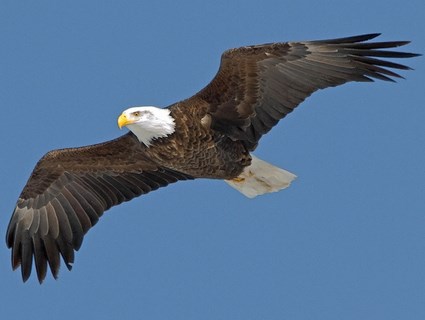
Adult Bald Eagle
Adult Bald Eagle

Although Mark was was little guy, he still weighed about 30-40 pounds. I had seen Eagles swoop down and grab salmon out of a river, but those are fish weighing 15-20 pounds. It seemed highly improbably that an Eagle could fly away carrying an extra 35 pounds.

When one of his disbelieving brothers asked how he got away. He told us the eagle dropped him right before putting him in its nest. He said he landed in a tree and it took him a while to get down. It did seem likely the eagle would drop its over-sized load, I thought, and how incredibly fortunate that Mark landed in a tree! But Mark had no talon marks on his shoulders or any other visible proof of this tale and the whole notion of him being carried aloft was just not believable. Still, he refused to budge from his story, so eventually we just let it go.

Some years later, I was traveling on the Mitkof Highway near Petersburg when an eagle flew into my windshield. The bird took quite a blow and landed on the side of the road. Still dazed, the eagle got up and just stood on the ground trying to get its wits about it. I stopped my car and got out to see if it had been injured. I was only about ten feet away from the bird and what struck me immediately was how big it was. Standing on the ground, it was easily 4 feet tall. With that height, its wing span was probably eight feet.

I remembered Mark’s story and was pretty sure a bird this size probably could pick up and fly away with a 35-pound fish – but a 35-pound kid? I wondered.

Kathy’s Story

In the summer of 1973, I invited my boyfriend, Armen, to come to Alaska to visit. We had met earlier that spring when we both worked at Mazzi’s Sicilian Restaurant in Eugene while attending the University of Oregon. As it happened, Dad was going hunting with Austin Meekin while Armen was in town and invited the two of us to come along. Little did we know that on this trip Armen would make a significant first impression on my dad, leaving an indelible positive opinion of the man I would marry that would define their relationship for years to come.

Back home in Syria, Armen’s experience “hunting” really amounted to target practice, shooting small birds and rodents. He was quite handy with a rifle, but had never experienced the thrill of big game hunting. So, when Dad invited him on a moose hunt, Armen jumped at the chance.

It’s a long, three-hour drive from Anchorage to Meekin’s lodge and we made small talk all along the way. We stopped just before we got to the lodge to “sight in” the rifles. We got out of the car and as Dad opened the trunk to get the rifles, he asked Armen, “Want some dope?”

Armen was shocked! Was Kathy’s dad really inviting him to share a joint? Did he hear the question right? He looked at me with surprise and confusion – his eyes seemed to asked, “How do I answer that question?”

At that moment, Dad realized his jargon had tripped up Armen and he laughed, ” Oh, you thought I meant…” I chimed in, “He means mosquito repellent; mosquito dope,” I said. We all laughed but Armen and I knew he had by being slow to respond  he had given the “correct” response; and that scored a point with my Dad.

We made our way to a gravel area and set up some targets against an embankment. Dad turned to Armen and asked if he had ever shot a rifle before. Down playing his experience, Armen said, “A couple of times.” Dad proceeded to tell him all about the rifle, how to load it, how to hold it to make sure it did not accidentally fire, how to aim it and what to expect when it fired. Armen listened intently and played the part of a novice quite convincingly.

They set up some targets and Dad fired from 100 feet away. His shots were all on the target, but at first little high and as he adjusted, a little low. Armen stood a little farther back from the targets and hugged the gun tightly, carefully taking aim. Bullseye! Dad let out a little grunt as if to say, “beginner’s luck.” Armen fired again. Bullseye! This time dad turned and looked at Armen as if to make sure it wasn’t someone else was firing.

“I think I”m getting the hang of this,” Armen said.

When Armen hit the last two bullseyes, Dad was amazed. It just never occurred to him that Armen might actually have experience shooting a rifle. As we packed up the rifles, Dad said, “You’re not a bad shot.”

Whether Dad was on to him or not, the shooting skill Armen demonstrated that day clearly earned Dad’s respect and, I might add, Dad’s approval to be my husband.

Border Tales

As told by Kathy 

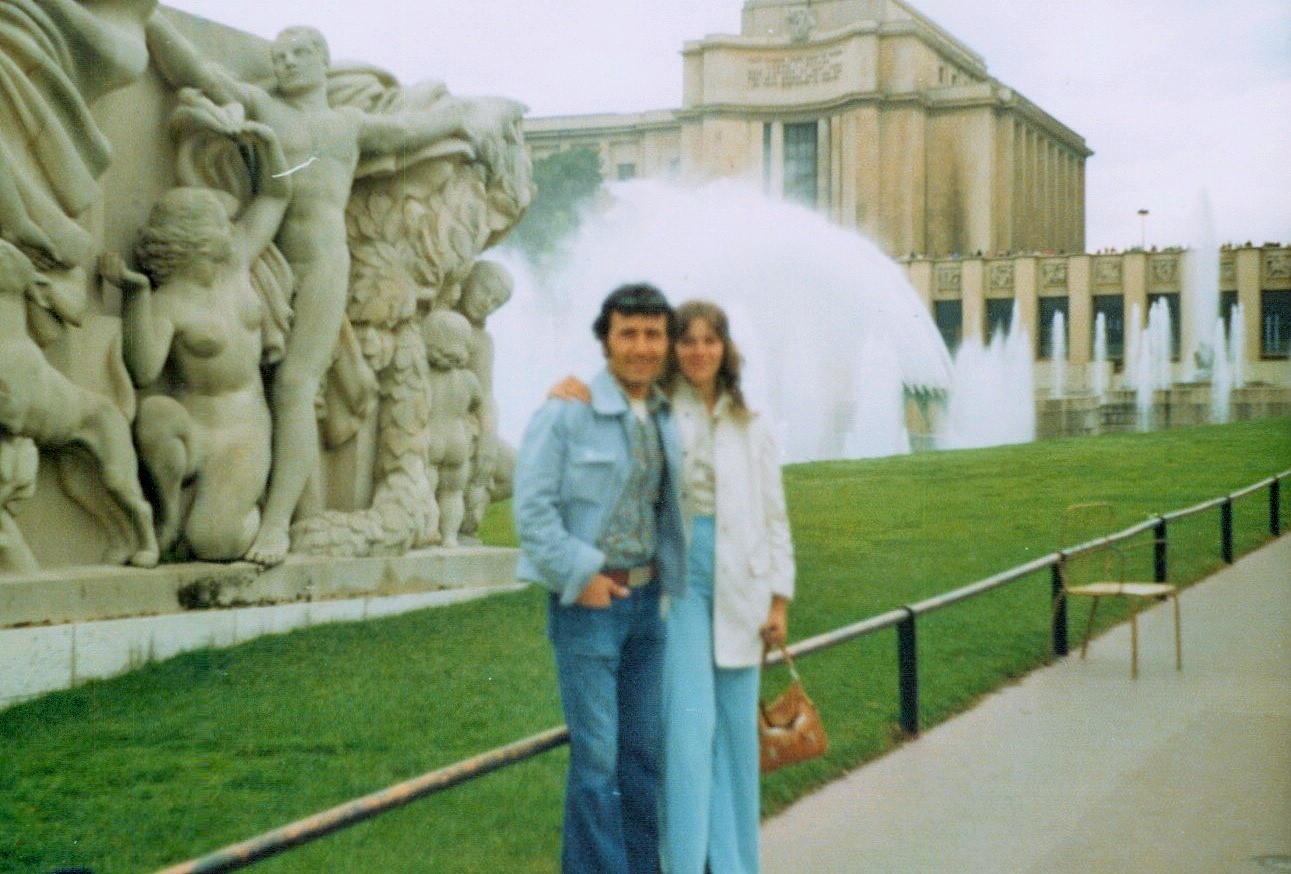
Armen and I graduated from college in 1974 and in August we began a three-month trip to Europe and the Middle East. I wanted to see the sights of Western Europe that I had heard about all my life – Big Ben and the changing of the guard at Buckingham Palace in England; the Eiffel Tower, the Arch de Triumph and Palace at Versailles in

The Palace at Versailles

France and, of course, the relics of the Roman Empire in Italy. We saw all that and more as we toured Western Europe for about four weeks and another three weeks in Eastern Europe. Armen wanted to see what life was like in socialist countries as well as take advantage of what he expected to be lower costs for food and other items like cameras there.

PART ONE

We did find a department store in Belgrade, Yugoslavia (Serbia today) but when we went there intending to buy gifts and mementos of trip, we saw that most of the shelves were empty. On a positive note, I remember seeing fathers caring for children – something you saw only very rarely in the U.S. back then, but it seemed quite common in Belgrade. There were few historic features I knew of in Eastern Europe, but it was memorable to see the Danube River.

We took the train from Belgrade and headed to Sophia, Bulgaria. As we settled into our cabin, several people Armen identified as Gypsies piled in with us. They looked like they just stepped off a movie set with their stereotypical clothing: folk-type shirts and blouses with full sleeves and ruffled cuffs, and full skirts and roomy pants made of simple fabrics. They all seemed to have “full figures”, their tight belts and waistbands pressing in on their soft stomachs. The women had full bosoms, their blouses closed tightly at the neck and broad hips covered by all the loose-fitting clothing. The men also appeared to have large chests and thick legs. Armen tried to make conversation with one of the men, but he was very focused on his group and not interested in small talk. We soon found out why.

Just a few minutes out of the station a customs agent entered our cabin asking us to declare any purchases were had made in Belgrade. We didn’t have any because the department store was so empty. We couldn’t understand the conversation between the agent and the Gypsies, but it was clear they also denied having anything to declare. The agent seemed to question this and so as proof, they threw open their bags and satchels to show the agent they had nothing to hide. The agent hesitated, but in the end he left without collecting any tariff.

The agent had hardly exited the cabin when the Gypsies began to transform themselves. They pulled dozens and dozens of colorful silk scarves out from under their clothing, they rolled up their sleeves to reveal silver bracelets and necklaces around their wrists and arms up to their elbows. They took off these and many other items and stashed it all in the bags that had been so empty for the customs agent. A short time later the Gypsies got off the train with all of their scarves stowed in their baggage and we continued on.

It was late at night when we reached the Bulgarian border. We expected to see some sort of station, but instead there was nothing. No building, no platform, not even a shelter like you see at bus stops. Then we got the surprise of our lives. One of the conductors came into our cabin accompanied by a military soldier. He was dressed in fatigues and carried a rifle. He signaled for us to collect our belongings and to come with him. We showed him our tickets to Sofia, but despite language barrier, we understood that we were to go with him. And when we got off the train and then the most frightening thing happened – the train left!

So, here we were, two young people left in the middle of nowhere with this soldier who appeared to be as unsure of the situation as we were. To this day, we still don’t know why they pulled us off the train. Armen tried to find out by speaking to the soldier in French – no response. He tried Arabic and Armenian, but the guard clearly didn’t understand those languages. When Armen tried Turkish the solider did not respond, but something in the guy’s eyes told Armen he understood. (Note: when travelling abroad, be sure to have a polyglot as one of your travelling companions!)

One of the things that first interested me about Armen was that he knew a lot about political systems, and socialist systems in particular. At that moment at that desolate spot along the Yugoslav/Bulgaria border the most important thing he knew was that those Eastern Block countries were always in need of Western currency. We weren’t wealthy travelers by any means, but we did have nearly $1,500 in Travelers Cheques. (There were no ATMs in those days). We pulled them out to show the guard and, speaking in Turkish, Armen explained that we intended to spend that money in Bulgaria. It worked. About an hour later, another passenger train stopped at the border and the soldier escorted us on board.

PART TWO

We went to the visitors’ office in Sofia to find lodging and discovered that for not too much money, we could rent a room adjoining someone’s apartment – clearly this was the predecessor to today’s Air BNB. It was a clean space with a private entrance and a balcony overlooking a main street. The next morning as we drank coffee on the balcony we noticed that people were lining up on both sides of the street below apparently to watch some sort of parade. We could see the beginning of the parade several blocks down the street and had just settled in to enjoy it when two large men barged into the apartment, charging directly at us and insisted that we step back into the apartment.

It turned out that the parade was part of a celebration of Bulgaria’s 30th year as a socialist country. In recognition of the occasion, the leader of North Vietnam was visiting and he was riding in the parade. The balcony we had been sitting on was a perfect spot from which to shoot someone in the parade. Remember the year was 1974. America’s involvement in Vietnam would soon some to an end, but it hadn’t ended yet. And so the prospect of an American (me) located on a balcony above the street on which the leader of North Vietnam would travel was too hazardous. Out an abundance of caution – and not wanting to be arrested – we decided to forego watching the parade. And the security officers made sure we didn’t, sticking around until the parade had passed.

That evening we did enjoy a wonderful multi-course meal for only about four dollars. Afterward we went for a stroll when suddenly we heard bombs exploding from about a block away. We could see the flare of each explosion and the sound was deafening, but no one else seemed to be concerned. As we rounded corner we realized these weren’t bombs but fireworks – more celebrating the country’s anniversary. It was really the first fireworks display I’d ever seen. Coming from Alaska where the long summer days wash out even the brightest fireworks, and it was spectacular.

After a few days in Sofia, we were ready to move on, but getting out of Bulgaria proved nearly as difficult as getting in. From Sofia, we planned to fly to Beirut, but there was one problem; we could purchase our tickets from only the visitor center and they refused to allow us to leave for another week.

PART THREE

We finally got to Beirut in mid-October. Several of Armen’s relatives had gathered at his sister’s house to welcome him home. There was great feasting and lots of conversations and catching up. Remember, there was no Internet or cell phones and in the Middle East, few people even had a phone. In the five years since he had left home, Armen had communicated with his family very infrequently through short letters and very occasional phone calls. So they had a lot of catching up to do.

Armen's childhood home
Armen’s childhood home

Amen had grown up in Syria, but he was not able to return there because he had left on an exit visa to Italy and illegally went to the U.S. instead. But he wanted me to see his home town so I traveled to Damascus and his home town of Aleppo with his nephew, Kapo, who had a good command of English. We visited his relatives in Syria, including his brother Hovhaness and landmarks such as a 2,000 year old suq, the ancient Citadel that protected Damascus for centuries, and, of course, Armen’s childhood home.

The only downside was I was getting eaten alive by mosquitoes. So we headed to a pharmacy for some repellent. Surprisingly, they not only didn’t have it, they didn’t even know what it was!

Pharmacy after pharmacy, it was the same response. Finally, we entered a pharmacy and as Kapo began explaining in Arabic what we were after, the clerk turned to look at me. My blue eyes, fair skin and light-color hair revealed my Western nationality and he said in English, “Oh, you want mosquito repellent.”

“Yes!” I said. Finally, someone knew what I was after! The clerk’s response was matter-of-fact, “We don’t have that,” he said.

I traveled two more times into Syria. The third time was during Ramadan, the Muslin holy month of fasting. We were taking a bus this time, and the station was packed with followers of Islam trying to get to Mecca as part of the religious observance. When it was announced that our bus was available for boarding, the crowd surged toward the door of the bus. Just then an officer who was on the bus appeared in the doorway, blocking those trying to get on. When they pushed forward, he drew a Billy club and threatened to hit them. When I saw this, I turned around and began walking fast away from the potential altercation. Kapo called to me, asking, “Where are you going?” “He’s going to hit people,” I said. Forgetting that I knew neither the language nor the culture, Kapo said in disbelief, “He’s threatening them so you can get on!” I turned back and sheepishly boarded the bus. At least I could prevent others from being injured.

On the way out of Syria on that third trip, we took a taxi to Beirut. It’s the custom there for taxi owners to predetermine their destination and then wait in a public place like the town square for enough riders to fill their car. As we neared the Lebanese border, we saw a long line of taxis waiting to go through the border checkpoint.The driver suggested to Kapo that he and I walk up to the front of the line since as a foreigner, I would have to fill out a lot of paperwork to cross the border while for the other passengers, it was much simpler, like U.S. citizens crossing into Canada.

I finished the paperwork and while I waited for our car to get to the front of the line, one of the border guards struck up a conversation straight out of an English language text-book, “How many brothers and sisters do you have?” he asked. “How old are they?”

When the car arrived, the guard asked if I had any purchases to declare. I said yes and showed him the packages in the trunk. Apparently as a compliment to me, the guard covered his eyes as he stamped each package with acknowledgement that no tariff need be paid. I expressed my appreciation for this, recognizing that he had done me a favor.

We got in the car and started to drive away when the guard suddenly started chasing the car, calling for us to stop. He swung open the back door, pointed at me and said in English, “You. Get Out!” Puzzled and now almost frightened of what was happening, I got out with Kapo who could translate if need be.

While we stood by the car, the guard slowly looked around to the left and then to the right. Then, in a quiet voice asked, “What are you doing Saturday night?”

Surprised doesn’t quite describe my reaction, but I was flattered and wanted to let the guy down easy. So, I told him that I was leaving to go home on Friday, thanked him for the invitation and said goodbye. When Kapo and I climbed back into the car all of the other passengers wondered what had happened. Kapo explained in Arabic that the guy just wanted a date. They all had a good laugh and clucked their tongues.

Tripoli, Lebanon

Four Wheeling over Indian Pass

As told by Kathy

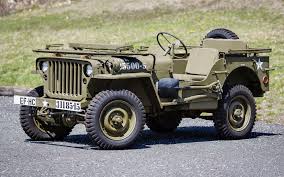
My family didn’t invent the term “four-wheeling,” but we were doing it long before some one else Jeepcoined the term. Of course, many of our adventures were made possible because our dad had the Jeep dealership and he generously loaned us cars off the sales lot to drive and, because my big brother, Russ, was always up for testing the off road capabilities of those four-wheel drive vehicles. As for Dad, he was pretty much always willing to give Russ – his “number one son” – any car he wanted. So. when Dad took an old open-top military style Willys Jeep in trade one summer day, Russ had the keys before the previous owner was off the lot.

This was the summer after Russ’ freshman year, and he had brought his college roommate, Kim Hutchinson, home with him. Kim no doubt was so intrigued with Russ’ story telling about Alaska that he just had to come see for himself the place where all those INCREDIBLE tales were born.

Kim was one of eight Hutchinson kids who grew up on a farm that was located smack in the middle of urban Portland, Oregon. It was a real working farm, with cows to milk, pigs to slop, sheep to shear, and fields of hay to cut and bundle. And Dr. Hutchinson, their dad, insisted that the kids do all the work. During the years I spend going to school in Oregon, I would come to know all the Hutchinsons. And they all had down-to-earth personalities more like country folk although they lived in a big city.

The first things you notice about Kim are his Bob Hope-type “ski jump” nose, his near-constant smile and his “take no prisoners” quick wit. Everyone was fair game for Kim’s sense of humor. Even my Dad, who had taken up the then-new pastime of jogging fell victim as Kim dubbed him “the Mad Jogger” or MJ or short. Kim was fun to be around; no one was too young or too old not to be invited to participate in any activity whether that be a conversation, a card game or even four wheeling. So, when Russ drove up in the Jeep ready for a manly adventure, he wan’t surprised to learn that Kim had invited his two little sisters, Genie and me to come along, and made no objection.

We piled into the Jeep and headed for the mountains that are the backdrop to Anchorage. We drove to the top of O’Malley road and they climbed higher up on Hillside Drive, but that was no problem for the sturdy little Jeep’s four-wheel drive. We turned onto a narrow road that took us to a parking area that was the trailhead to hikes in Paradise Valley. From there you could see what was more like a sort of trail that led as far as the eye could see through Indian Pass.  It was a mystery to us why the pass had that name; as far as we knew,  no Native American tribes had every inhabited that valley.

Being without seat belts, we all hung on tight to our seats as Russ drove through the parking area, down a small embankment and then shifted into gear to steer the Jeep through the deeply-rutted pathway to Indian Pass.  The mystery of the route’s name just added to our sense of adventure, along with the condition of the “road.” It had rained recently and the road was sloppy with soft spots, but as we plowed through each of the mud holes, we knew they required just enough effort to give us a tale to tell. Little did we know we’d have a much bigger story to tell about driving over Indian Pass.

This path was a utility access road, that followed the natural contour of the valley floor. There had been no roadwork to flatten the peaks or fill in the dips or to grade it to even it out, but we loved it. As the road twisted it rocked us back and forth; as we drove over rocks and ruts we bounced up and down and almost out of the Jeep! What we didn’t realize as we drove along was that the road was gradually climbing to an elevation at the end of the valley of nearly 4,000 feet. The consistency of the road was changing too – it was more rock than soil and the rock was shale, a brittle rock that easily breaks and splinters with razor-sharp edges. Taken together, these facts were about to make this ride much bumpier.

I’ll never forget it – in one moment we were happily twisting, turning and bouncing in our seas as Russ navigated the Jeep through the ruts and around the rocks in the road, constantly shifting to lower gears as we went over a hill, or higher gears to as we met a dip in the road, maximizing the Jeep’s ability to overcome the road’s obstacles. Genie and I sat in the back, singing Beatles songs and enjoying this “thrill ride.” We never gave a thought to the possibility that this could be dangerous. Despite the uneven road, we were making a steady 25-30 miles per hour when we rounded a curve and Russ suddenly slammed on the brakes.

The abrupt stop threw Genie and me against the backs of the front seats and it sent Russ and Kim lurching into the dashboard. Luckily no one was hurt and as we got back into our seats we could seen what caused Russ’ swift reaction. From my perspective in the back seat the road appeared to end at the edge of the cliff. We all got out and then we could see that the road did continue, but it was as steep as the first downhill slope of a roller coaster only without the rails to guide us down. I couldn’t believe that anyone had intentionally built a road this steep. It was INCREDIBLE! I don’t think I’ve ever been on even ski slope that steep, let alone a road. To make matters worse, the road consisted of thousands of chunks of loose, sharp, shifting pieces of broken shale. Now this really was an adventure.

Russ and Kim immediately started to consider the options. We could go back the way we came, but where was the adventure in that? We could just go for it – that would be high on adventure but just as dangerous as we wouldn’t be able to slow our descent. The brakes were of little use to us because the Jeep would just slide on the broken shale. If we couldn’t slow the Jeep, we could get going too fast, lose control and veer off the road into the trees. The gears offered one possibility – but even in low gear there was no guarantee that we could go slow enough to maintain control. There was another gear that proved to be the answer: reverse.

One thing was certain – Genie and I were walking down – that was treacherous enough as the sharp-edged shale slid beneath us with each step – but it was still much safer than being in the Jeep. Russ and Kim got in and Russ slowly drove the Jeep over the crest of the hill.  As soon as the Jeep hit the shale, it immediately began to slide and twist sideways. Russ put the Jeep in reverse and while it continued to slide, the backwards-turning wheels provided just enough resistance to allow Russ to straighten it out and slow it down so Russ could maintain control. it probably took only about five minutes for Russ to drive the Jeep to the bottom of of the steep, shale-covered slope, but it seemed much longer as we all held our breath in anticipation.

When they finally reached the bottom of the slope safely, we all gave up a cheer and piled back into the Jeep. The road was again soil and in much better shape than the one through the valley. We continued on at a good pace and before long we surprisingly came to the highway along Turnagain Arm. The Alaska Railroad runs alongside that highway and as we turned onto the pavement, we noticed a railroad location marker that cleared up one mystery. It read simply, “Indian.”